Monday, February 5, 2024


Abortion - a biblical perspective

It always helps to start with a definition - 


America is on the precipice of a national crisis.  The Democrat party is planning to put the "right" to abortion front and center in the 2024 Presidential Election.  The Dobb's decision, returning this matter to the states, was announced by the US Supreme Court in the summer of 2022 which was a reversal of the 1973 Roe vs. Wade decision.


As of the date of this writing, 25 states have banned abortion or tightened restrictions on the procedure, but not all of these laws have gone into effect as some are being challenged in court.  The other 25 states, along with the District of Columbia, either kept or strengthened the key tenets of the Roe decision or were blocked from changing their laws by the voters and the courts.  Of note, there are 24 countries in the world where abortion is illegal in any and all circumstances.

Roe and the subsequent ruling in Casey upholding it were two of our nation's most infamous examples of flawed constitutional law, driven by pure judicial willfulness and ideology. The Constitution simply does not protect a right to choose abortion, and the Justices who created this right perverted the document in order to impose on the entire nation their own moral-political opinions about the desirability of abortion.

I acknowledge two components to the construction of my thoughts on this matter.  1) I am male, and 2) my beliefs are informed by my biblical world view.

So, just what does the Bible have to say about this topic?  There is a theological term, Imago Dei, that speaks volumes on this issue.  Imago Dei means "image of God" and refers to the fact that we bear His image thru the creative works as described in Genesis.

So God created man in His own image, in the image of God He created him; male and female He created them.  Genesis 1:27

The Bible also instructs us that God is aware of and calls us, even in our preborn state.  These verses tell us that we are not just a clump of cells, but are truly preborn individuals worthy of God's attention.

 “Before I formed you in the womb I knew you,
And before you were born I consecrated you;
I have appointed you as a prophet to the nations.” Jeremiah 1:5

 Listen to Me, you islands,
And pay attention, you peoples from afar.
The LORD called Me from the womb;
From the body of My mother He named Me. Isaiah 49:1

 But when He who had set me apart even from my mother’s womb and called me through His grace was pleased Galatians 1:15

For You created my innermost parts;
You wove me in my mother’s womb.
14 I will give thanks to You, because I am awesomely and wonderfully made;
Wonderful are Your works,
And my soul knows it very well.
15 My frame was not hidden from You
When I was made in secret,
And skillfully formed in the depths of the earth;
16 Your eyes have seen my formless substance;
And in Your book were written
All the days that were ordained for me,
When as yet there was not one of them. Psalms 139:13-16


 ‘Your hands fashioned and made me altogether,
Yet would You destroy me?
9 Remember that You have made me as clay;
Yet would You turn me into dust again?
10 Did You not pour me out like milk,
And curdle me like cheese,
11 Clothe me with skin and flesh,
And intertwine me with bones and tendons?
12 You have granted me life and goodness;
And Your care has guarded my spirit. Job 10:8-12

2 This is what the LORD says, He who made you
And formed you from the womb, who will help you:
‘Do not fear, Jacob My servant,
And Jeshurun, whom I have chosen. Isaiah 44:2

We also can see from scripture that the preborn are referred to as children, or babies, not just a fetus.

When Elizabeth heard Mary’s greeting, the baby leaped in her womb, and Elizabeth was filled with the Holy Spirit.  And she cried out with a loud voice and said, “Blessed are you among women, and blessed is the fruit of your womb!  And how has it happened to me that the mother of my Lord would come to me?  For behold, when the sound of your greeting reached my ears, the baby leaped in my womb for joy.  And blessed is she who believed that there would be a fulfillment of what had been spoken to her by the Lord.” Luke 1:41-45

“Now if people struggle with each other and strike a pregnant woman so that she gives birth prematurely, but there is no injury, the guilty person shall certainly be fined as the woman’s husband may demand of him, and he shall pay as the judges decide.  But if there is any further injury, then you shall appoint as a penalty life for life,  eye for eye, tooth for tooth, hand for hand, foot for foot,  burn for burn, wound for wound, bruise for bruise. Exodus 21:22-25

 “May the day on which I was to be born perish,
As well as the night which said, ‘A boy is conceived.’ Job 3:3

Given all the texts above, it is obvious that God sees the preborn as having worth, and actually proclaims them "persons".  If we can agree that the unborn are innocent humans, then we are faced with a direct prohibition against abortion.

 “You shall not murder. Exodus 20:13

Since the Roe decision in 1973, there have been over 63 million abortions performed in this country.  The number is likely higher as there are probably many abortions that go unreported.  Even if we accept the 63 million number it is easy to extrapolate some of the impacts to this nation as a result of legalized abortion.  First, we note a significant decline in the trend of annual birth rates.  While we can't assign all of the decline to abortion, we can easily assume that this practice has had a significant impact.  Imagine if we had 63 million additional folks working in this country, contributing to the economy by paying taxes and social security.  Perhaps social security would have a longer lifeline and wouldn't go broke as soon as currently projected.


The pro choice group is  militant, and they will be very vocal during the leadup to the November election.  These are folks who, for the most part, understand what they are doing, but will speak in euphemisms to try to lessen the horror of baby murder.  They will cry about reproductive rights, even though the process is destructive, not reproductive.  There is nothing reproductive about abortion.  Given that the process involves terminating a life, we can also state that no rights exist to allow for murder.

Another euphemistic phrase commonly heard is reproductive health care.  We've already discussed the term reproductive, now let's look at the next two words.  There is nothing healthy or caring about abortion - nothing.  Note the claims of Priscilla Coleman of Bowling Green State University, the author of the meta-analyses published in what the website termed the "prestigious British Journal of Psychiatry." Namely:

"Women who have had an abortion have an 81 percent higher risk of subsequent mental health problems compared to women who have not had an abortion.

"Women who aborted have a 138 percent higher risk of mental health problems compared to women who have given birth.

"Women who aborted have a 55 percent higher risk of mental health problems compared to women with an 'unplanned' pregnancy who gave birth.

"Women with a history of abortion have higher rates of anxiety, depression, alcohol use/misuse, marijuana use, and suicidal behavior, compared to those who have not had an abortion."

May God continue to have mercy on this nation

Tuesday, April 18, 2023

 US Tax Code and Social Engineering


Social engineering refers to the use of policies and programs to influence or shape the behavior and values of a society. The US federal government has been using its tax system as a tool for social engineering for decades. However, there are those who argue that this is an evil practice because it goes against the principles of individual freedom and choice. Here are ten points to consider when evaluating the argument that US federal income taxes are evil due to their use in social engineering:


1. Coercion: One of the main arguments against the use of taxes for social engineering is that it amounts to coercion. When the government uses tax revenue to promote certain behaviors or values, it is essentially forcing citizens to comply with its agenda, even if they do not agree with it.


2. Individual freedom: The use of taxes for social engineering also goes against the principle of individual freedom. Citizens should have the right to make their own decisions about how they live their lives, without government interference.


3. Economic efficiency: Another argument against the use of taxes for social engineering is that it can be economically inefficient. When the government tries to influence behavior through taxes, it can distort market incentives and lead to unintended consequences.


4. Unintended consequences: The use of taxes for social engineering can also have unintended consequences. For example, when the government offers tax breaks for certain behaviors or activities, it can create a perverse incentive for people to engage in those activities, even if they are not in their best interest.


5. Ineffectiveness: There is also evidence to suggest that using taxes for social engineering can be ineffective. For example, when the government tries to use tax breaks to promote certain types of energy production, it may not actually lead to a significant increase in the use of those energy sources.


6. Political bias: The use of taxes for social engineering can also be influenced by political bias. When one party is in power, they may use tax policy to promote their own agenda, rather than what is best for the country as a whole.


7. Unfairness: The use of taxes for social engineering can also be seen as unfair. For example, when the government offers tax breaks for certain behaviors or activities, it can create a situation where some people benefit more than others, based on their ability to take advantage of those tax breaks.


8. Complexity: The tax code is already complex and difficult to navigate. When the government adds social engineering goals to the mix, it can make the tax code even more confusing and difficult to understand.


9. Lack of transparency: Finally, the use of taxes for social engineering can lack transparency. When the government uses tax revenue to promote certain behaviors or values, it may not be clear to citizens exactly what the government is trying to achieve.


10. Alternatives: There are alternatives to using taxes for social engineering. For example, the government could use education campaigns or public-private partnerships to achieve its goals, rather than relying solely on the tax code.


In conclusion, there are valid arguments to be made against the use of US federal income taxes for social engineering. While some may view it as a necessary tool for promoting certain behaviors and values, others see it as an evil practice that goes against the principles of individual freedom and choice. Ultimately, the question of whether taxes should be used for social engineering is a complex one and requires careful consideration of the costs and benefits of such policies.


One potential solution to this issue is to focus on simplifying the tax code and reducing the overall burden of taxation. This would not only make the tax system fairer and more transparent, but it would also reduce the need for social engineering policies that often lead to unintended consequences and market distortions.


Another alternative to using taxes for social engineering is to focus on promoting individual responsibility and choice. Governments can provide education and information to citizens about the benefits and risks of certain behaviors, and then leave it up to individuals to make their own decisions. This approach would respect individual freedom while still achieving the government's goals of promoting certain behaviors and values.


Ultimately, the use of taxes for social engineering is a controversial issue that requires careful consideration of the costs and benefits of such policies. While some may argue that it is an evil practice that goes against the principles of individual freedom and choice, others may argue that it is a necessary tool for promoting certain behaviors and values. Regardless of one's position on this issue, it is important to continue to have an open and honest dialogue about the role of taxes in shaping society, and to carefully consider the costs and benefits of any policies that are implemented.


Saturday, April 8, 2023

The Silence of Saturday


No doubt, this was a dark day.  So dark, that the only mention of the events of this day are these few verses in Matthew 27:

The next day, that is, after the day of Preparation, the chief priests and the Pharisees gathered before Pilate and said, “Sir, we remember how that impostor said, while he was still alive, ‘After three days I will rise.’ Therefore order the tomb to be made secure until the third day, lest his disciples go and steal him away and tell the people, ‘He has risen from the dead,’ and the last fraud will be worse than the first.” Pilate said to them, “You have a guard of soldiers. Go, make it as secure as you can.” So they went and made the tomb secure by sealing the stone and setting a guard.


Today, we find ourselves on a truly unique day in our Christian faith. We are caught between the defeat of Good Friday and the victory of Easter Sunday. We are on a time of reflection and doubt, a time of confusion and questioning. We are in the middle of Silent Saturday.

Silent Saturday is a day where we are reminded of the silence that must have filled the air on that day so long ago. It was a day between defeat and victory, a day where the disciples were left wondering what went wrong. They had seen their beloved Lord and teacher humiliated, beaten, and brutally put to death. They were shattered and deeply confused, they would have questioned everything they had believed in at that point, and they would have doubted. It was a day that was filled with uncertainty and fear, it was a day of silence, where the echo of Christ's final breath still resonated in the air.

It is during this time of waiting, this season of silence, that we must remember what Christ said to his disciples. Even though everything seemed bleak, even though they had just witnessed a horrific death, Jesus had promised that he would rise from the dead on the third day. We must remember that in our time of confusion and questioning, we can look forward to a better tomorrow. We must hold on to hope because we know that Sunday is coming.

Silent Saturday is an essential part of the Resurrection story for a reason. It is a time when we must allow ourselves to feel confused, to doubt what we have been taught, and to wonder. It is through these emotions that we will be able to appreciate the tremendous victory that Easter Sunday offers. Before we can celebrate the resurrection, we must sit in silent perplexity and learn from it.

Silent Saturday teaches us that sometimes, we must face tribulations before we can bask in triumphs. We must fall so that we can learn to dust ourselves off and rise. Like Christ's resurrection, we are promised our own rebirth after facing our own Good Fridays.

Perhaps you are going through a Silent Saturday of your own right now. Maybe you're struggling with a feeling of loss or defeat, confused and questioning why things are unfolding the way they are. We may be left asking God, "Why?" And it's okay if we do. We must remember the power in the silence and the strength in questioning. Sometimes, the only way we can move forward is to sit with our frustration, to embrace our doubts, and to listen in the stillness for the answer.

But as Christians, we must hold on to our faith knowing that God is with us, just as he was with the disciples on that Silent Saturday. Our faith reminds us that whatever happens, no matter how seemingly bleak the situation may become, our hope is in the Lord, who has already shown us the way.

As we sit in today's 'silent Saturday', let us allow ourselves to ask questions, and listen for God's answer in the quiet of our souls. May we learn the wisdom in the waiting because we know Sunday is coming, and with it, our redemption.

So, let us use this time of Silent Saturday to introspect, examine our faith, and get ready for Easter Sunday when we celebrate our triumphant Savior, who has risen from the dead.

May God Bless you all and have a blessed Saturday. Amen.

Friday, October 28, 2022


personhood

[ pur-suhn-hood ]


noun
the state or fact of being a person.
the state or fact of being an individual or having human characteristics and feelings:


“What is man, that thou art mindful of him?”  With these words, the Psalmist asks a very important question. It is a question that forces thoughtful consideration of the disparity between the Divine mind and the human intellect, while at the same time postulating that in humanity there is, within our nature, intrinsic worth in the eyes of God.

For Christians, the term imago Dei (Latin for "the image of God") holds significant importance.  Augustine defined as “that principle within us by which we are like God, and which is rightly said in Scripture (Genesis 1:26-27) to be made ‘after God's image’” (Augustine ca. 397/2002).   The idea that some part of the Divine rests in all of humanity is core to the tenet of personhood.  It is this belief that drives our beliefs, morals, and is the basis of many of the laws that exist today.

Not just Christians, but the secular world has also long pondered the concept of Personhood.  Around 380 BC, Plato offered that "when the person has died, his soul exists", and in furtherance of his comments found man as "having a share of the divine attributes."  Plato found intellect as the principal distinctive separating Man from animal.  Aristotle concurred saying that "the human race exists by means of art also and the powers of reasoning."

Pliny the Elder described man as “the animal destined to rule all others.” Even Darwin, the father of the theory of evolution, held that "the high standard of our intellectual powers and moral disposition" also reflected evolutionary advancement.  Further, Darwin concluded that the construct of a Deity allowed man to transform behaviors into "habitual convictions controlled by reason".  In his later years, Darwin would go further:

Another source of conviction in the existence of God, connected with the reason and not with the feelings, impresses me as having much more weight. This follows from the extreme difficulty or rather impossibility of conceiving this immense and wonderful universe, including man with his capacity of looking far backwards and far into futurity, as the result of blind chance or necessity. When thus reflecting I feel compelled to look to a First Cause having an intelligent mind in some degree analogous to that of man; and I deserve to be called a Theist….

I cannot pretend to throw the least light on such abstruse problems. The mystery of the beginning of all things is insoluble by us; and I for one must be content to remain an Agnostic (Darwin 1887/2005).

St. Thomas Aquinas stated clearly that "it belongs to the notion of man to be composed of soul, flesh, and bones", thus supporting his theory of the Trinity of Man.  John Locke accepted the concept of soul but viewed personhood of the individual as a distinct state, closely tied to consciousness— "Socrates asleep, and Socrates awake, is not the same person…. For if we take wholly away all consciousness of our actions and sensations, especially of pleasure and pain, and the concernment that accompanies it, it will be hard to know wherein to place personal identity” 

Some will remember recent legal arguments centered on the topic of personhood.  The Honorable Barry Schaller (2008), an Associate Justice of the Connecticut Supreme Court, noted that such questions were central to the recent case of Terri Schiavo.

The case of Terri Schiavo…raised a virtual cascade of questions that concern the state of American society and culture. What is the nature of personhood and when does it end? What level of respect and, with it, autonomy accompanies an individual into old age or incapacity?

As the human body deteriorates, does personhood devolve? Is an ill or dying human being accorded less status as a person than others? Such propositions directly question whether personhood is a conditional state rather than an innate characteristic of human beings. If personhood can end before life ends, then human nature becomes a fragile expression of self-awareness, and is not a robust and inalienable foundation of human rights and culture.

The Apostle Paul directly addressed the transcendence of human personhood by teaching that personal identity survives physical death, stating that “we are confident, I say, and willing rather to be absent from the body, and to be present with the Lord.” Speaking of the end of life, Tertullian held that human personhood was not removed in impending death but rather limited in its fullest expression. Tertullian stated that

when death is a lingering one, the soul abandons its position in the way in which itself is abandoned. And yet it is not by this process severed in fractions: it is slowly drawn out; and whilst thus extracted, it causes the last remnant to seem to be but a part of itself. No portion, however, must be deemed separable because it is the last; nor, because it is a small one, must it be regarded as susceptible of dissolution.

The concept of conditional personhood is morally flawed.  It is similar to the argument that the fire of a single birthday candle is subservient to a bonfire.  Fire exists, and regardless of the state or condition of the fire, there is an inherent capability for the fire to expand.

Likewise, we find ourselves at the controversial topic of personhood at the beginning of life.  This debate also reached back to antiquity.  the Pythagoreans believed that the contents of a mother's womb was "a living being, ensouled from the moment of conception, and that ensouled human life. as divine in par, was to be inherently respected and protected until natural death."

If we recognize the concept of personhood, we place upon society certain requirements.  Society must recognize the worth of the individual once personhood is established.  We are also faced with the concept that personhood is not a "right", if we define rights as possessions of the person and not as attributes which define an individual.

It is within this struggle to define and assign rights to personhood that we find ourselves today in the aftermath of Roe v. Wade.  Justice Blackmun explicitly noted that “the Constitution does not define “person” in so many words.”  Roe was finally settled with a focus on fetal development and not on personhood. Justice Blackmun held that the State

has legitimate interests in protecting both the pregnant woman's health and the potentiality of human life, each of which interests grows and reaches a “compelling” point at various stages of the woman's approach to term.

In Roe, the fetus gained no recognition of personhood, and the rights of the fetus were not recognized or established. Its interests were held to increment with fetal development as with the ability of the fetus to survive. The political rights of personhood were vested with viability. 

Christians, however, point to the absolute truths of the Declaration of Independence -

We hold these truths to be self-evident, that all men are created equal, that they are endowed by their Creator with certain unalienable Rights, that among these are Life, Liberty and the pursuit of Happiness. —That to secure these rights, Governments are instituted among Men, deriving their just powers from the consent of the governed… 

Created equal is a powerful statement.  It imputes a beginning, and in that beginning, an existential state of being.  If a being exists at time of creation, then, most certainly, the arguments of personhood are moot.

It is clear from the earlies teachings of scripture that abortion is an evil that is an afront to a Holy God.  Hear the words of Psalm 139:16

Your eyes have seen my unformed substance;
And in Your book were all written
The days that were ordained for me,
When as yet there was not one of them.
and Proverbs 6:16-17

There are six things which the Lord hates,
Yes, seven which are an abomination to Him:
Haughty eyes, a lying tongue,
And hands that shed innocent blood,

Christians cannot support those politicians that support abortion.  It is a violation of all that is good and right.  We must approach this issue with the idea of personhood - that, at conception, a living organism is started on a marvelous developmental journey that will manifest in a human form of imago Dei.
If we realize that the womb contains life, and we have no right to terminate that life, we will arrive at the destination that abortion is murder, and cannot be allowed, under any circumstance.
Upon this truth, I stand!


Thursday, January 28, 2016

I Dare Men to Read this Book


I Dare Men to Read this Book


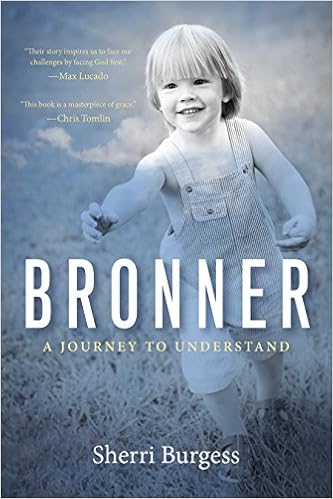
Bronner: A Journey to Understand is a book that will grab you, consume you, and, unless you are reprobate, will certainly impact you!  Men – you probably will want to read this alone – no one needs to see another ugly faced cry!
We’ve all known pain.  We’ve all experienced grief.  Like Job of the Bible, we may have even shaken our fist at God and wondered why He would allow us to be born just to suffer the tragedies of this life.  Well, if you want the answers, grab a copy of this book.

A German Philosopher (Gottfried Leibniz) coined the term “Theodicy” way back in 1710 – Sherry Burgess became personally acquainted with the term on January 19, 2008.  Fear gripped her entire body as she said those two fateful words, “Where’s Bronner?”  When she found him face down in the family pool, her world was shattered.  “My whole life – everything – was over. Not that I had given up yet. I thought he could be revived. I was hoping for resuscitation, but, even so, I knew that from that moment on nothing would ever be the same.” (p. 55)
 It is a violation of the laws of nature for parents to bury their children.  For those of us who have not experienced this particular tragedy, we can probably come nowhere close to understanding the depths of that level of grief.  We can sympathize, but empathy is foreign to us.  Your sympathy gene will be stretched as you turn the pages of this book.  From the joys of a mother sharing how complete her life is with her young, new son to the grief associated with Bronner’s drowning, to following Sherri’s journey to pursue God for answers, the emotional roller coaster of this book is beyond most things I’ve ever read.

 As dark, bleak, and tragic as that winter day in 2008 was for the Burgess family, the journey revealed that even this was a part of God’s plan.  Triumph arose from tragedy, a testimony (and wow, what a testimony) grew from this family’s trial.  By the time you turn the last page, hopefully you too will understand that God is still in control!

Disclosure of Material Connection: I received this book free from the publisher through their bloggers review program. I was not required to write a positive review. The opinions I have expressed are my own. I am disclosing this in accordance with the Federal Trade Commission’s 16 CFR, Part 255: “Guides Concerning the Use of Endorsements and Testimonials in Advertising.”

Friday, April 3, 2015

Tetelestai

It's Greek to me.  But it's important!  It's one of the Seven Sayings of Christ from the cross.  But its meaning is so misunderstood, often in a limiting, unheralding way.  But isn't that just like us, to limit the power of Christ to the point it can fit neatly within the confines of the box we construct to house it?  Let's explore this word.

In its' simplest, least complex definition, this word means (as translated in your KJV), "It is finished".  In my lifetime, I have heard countless sermons on those three words.  Powerful words, no doubt, that proclaim Christ understands His work on earth is now done.  His job is completed, the sacrifice has been offered.  Truly, this is an emphasis of this word. 
Spurgeon says this word conveys “an ocean of meaning in a drop of language, a mere drop. It would need all the other words that ever were spoken, or ever can be spoken, to explain this one word. It is altogether immeasurable. It is high; I cannot attain to it. It is deep; I cannot fathom it. IT IS FINISHED is the most charming note in all of Calvary’s music. The fire has passed upon the Lamb. He has borne the whole of the wrath that was due to His people. This is the royal dish of the feast of love.” 

But let's go deeper.


First, understand the tense of this verb - the perfect tense.  As in the English language, this tense of this verb describes an action which is viewed as having been completed in the past, once and for all and not needing to be repeated.  Doesn't it just make sense that this is in the "perfect sense"?  I would submit it is common sense to think the King of Kings could accurately and thoroughly complete an action such that no rework would ever be required!

Second, understand this was not a theological word at the time Christ uttered it from Calvary.  Rather, it was quite a common term in many areas of life.  Merchants used this term as debt accounts were closed.  Upon payment of your bill, the holder of the debt would write across the top - Tetelestai, Paid in Full.  Paid in Full means you don't ever owe anything else on that debt - it has been cancelled through full performance of payment of all money owed.  What was he paying - my sin debt, and yours.  There is therefore now no condemnation to them which are in Christ Jesus Romans 5:8.

The Roman Penal system utilized this word.  When a person was incarcerated, a complete list of the charges against them was posted on the exterior of their cell so there could be no doubt of why the person was in prison.  When the sentence was served, the charges were taken down upon the prisoners release and given to the judge who wrote across the top, Tetelestai!

It was a common word to indicate a project had been completed or a goal had been accomplished.  Workers used this word in admiration of the finished jobs.  Artists admired their creations while uttering this word.  Soldiers used this as a victorious chant when marching home from a successful battle.  Those who were returning home as victors who had vanquished their enemies were very fond of marching to this word.

This was the last of the seven sayings from the cross.  I don't suppose in His weakened state that the volume was much more than a whisper.  Only those that were close to the cross heard him.  Only those that were paying attention to him could have heard this word.  One of those was a Centurion.  A Centurion was a Roman officer that commanded, at a minimum, 100 soldiers.  He would have heard this chant before.  He would have recognized its' intended meaning.  This word, and this Man's life had an impact on the Centurion because he too had marched home victoriously while chanting Tetelstai! 

Now when the centurion, and they that were with him, watching Jesus, saw the earthquake, and those things that were done, they feared greatly, saying, Truly this was the Son of God.  Matthew 27:54


Saturday, October 25, 2014

Where did the other dollar go?


Three friends have a nice meal together, and the bill is $25

The three friends pay $10 each, which the waiter gives to the Cashier

The Cashier hands back $5 to the Waiter

But the Waiter can't split $5 three ways, so he gives the friends one dollar each and keeps 2 dollars as a tip.

They all paid $10 and got $1 back. $10-$1 = $9

There were three of them 3 X $9 = $27

If they paid $27 and the waiter kept $2: $27+$2=$29

Where did the other dollar go? $30 - $1 = $29

Thursday, October 23, 2014

Have you raised your Ebenezer?


Here I raise my Ebenezer;
Here by Thy great help I’ve come;
And I hope, by Thy good pleasure,
Safely to arrive at home.

 
These lyrics are from the traditional hymn, "Come thou Fount of Every Blessing." Before your mind starts racing, the lyrics aren't referencing hoisting Ebenezer Scrooge on a pitard.

Some context is in order to help us understand. Samuel grew up in the church, under the care of Eli, along with Eli's two sons Hophni and Phinehas. Samuel had to deliver the disastrous news to Eli that God was not happy with him and his sons and that they would soon perish, which happened shortly. During that battle, the ark of the covenant was lost, taken by the Philistines where it remained over the winter until the Philistines sent it back on a cart pulled by two dairy cows.

The ark made the 20 mile journey to Bethshemesh, where farmers saw the cart with the ark and a great celebration took place. But they weren't totally ready for the responsibility of caring for this relic so some men were summoned from Kirjath jearim to come take the ark from them. A fellow by the name of Eleazar was given the responsibility of caring for the ark and he did so for the next 20 years - apparently alone!

During these 2 decades, the people of Israel lived a miserable existence. The presence of God was absent from their life and the Philistines defeated them in battle consistently. Imagine this country's outlook if we were to undergo a 20 year war!

Samuel tried to console the people and to tell them there was hope. He presented to them 5 conditions of deliverance:


·         Return to God with all the heart

·         Put away all strange gods

·         Put away Ashtaroth

·         Prepare hearts for worshipping the true God

·         Serve God only
 

Samuel stated this conditional promise to the nation with the understanding that, if the conditions were met, that God would deliver them from under the oppressive hand of the Philistines.  Their contrition proved true this time, as the nation met at Mizpeh for a time of repentance and revival.  An interesting note in the midst of this story is found in 1 Samuel 7:8.  Gathered for a time of renewal and repentance, the people beg the man of God to not stop praying for them.  THEY SHOULD HAVE BEEN PRAYING FOR THEMSELVES ALL ALONG!

The Philistines, seeing the great assembly of folks in the small site at Mizpeh decided this would be a great time to launch another assault.  How could they not win – it would be like shooting fish in a barrel!  But God…

Don’t you just love that phrase!  God had other plans.  Notice in the KJV, in verse 10, the Bible says that God discomfited them.  Love that word.  It means technically “made them to be ill at ease”.  In redneck terms, they was skeered!  And they should have been, for once again God was on the side of his rebellious children and a great slaughter of Philistines was exacted.

Now back to Ebenezer-

In verse 12 we read the following:

Then Samuel took a stone, and set it between Mizpeh and Shen, and called the name of it Ebenezer, saying, Hitherto hath the LORD helped us.

I’ve come to realize that there is a lot of stone work that takes place in the Bible.  But let’s focus on this stone.  After a time of rebellion, a time of repentance, and a time of restoration, it was now time for rejoicing.  Samuel wanted to make sure that this time would be memorialized in the annals of their history – an important milestone in their walk with God.  The stone symbolized that up until now (signified by this here rock) God has sustained us, God has provided, and God has prevailed.  By looking upon this memorial, faith could be strengthened – because God has helped to date, by faith I’ll look for him to help tomorrow!

I think these stones were the refrigerator magnets of their time.  We have all kinds of reminders in our lives – our daytimers are filled with post-its, our phones are filled with alerts, our cars beep to remind us to buckle up, remove the keys when we turn off the engine, and so on.  These stones meant the same to them – a reminder of what God HAS DONE.  Because of what He HAS DONE, we can have faith in what he WILL DO.

A more recent musical take on this theme is found in the song Safe Thus Far. 

I just came from the throne room today, been talking with Him. And I was reminded were i am and where I've been. I've sailed many waters rough and deep, but someone has sailed each one with me. Safely and sure I've weathered the storms with my dearest friend.

Chorus
Yes, I am safe thus far, He's brought me safe thus far. I'm in the ship with the one who made the moon and the stars. I'll praise him for mercy that can't fail, amazing grace that still prevails. This is my story, I'll give Him the glory safe thus far.


Raise your own Ebenezer and have a listen to a great version –

https://www.youtube.com/watch?v=q7hyCoB83ss

Monday, September 2, 2013

Clear Winter Nights


In Clear Winter Nights (A journey into truth, doubt, and what comes after) we have what professes to be "Theology in Story".  The main subject of the book is dealing with the faith journey of themain character Chris and compares this journey to the seasons of our natural climate.

Are you looking for great literature?  This ain’t it!  Metaphors abound in this somewhat clumsy book.  Chris comes to see Gil in a blizzard and is snowed in. As Chris starts to ‘thaw’ so does the snow. When Chris leaves Gil’s having rediscovered his faith, the ‘days are getting warmer now.’ It is not very subtle and it seems a bit much.

But the theology is rich and much more enjoyable to read than many dry texts on theology which somehow robs God of his glory. The conversations in this book are interesting discussions and the discussion questions offered at the back (several questions for each of the eleven chapters) could help inspire many more such conversations in real life.

I would give this book 3 stars.

Disclosure of Material Connection: I received this book free from the publisher through their bloggers review program. I was not required to write a positive review. The opinions I have expressed are my own. I am disclosing this in accordance with the Federal Trade Commission’s 16 CFR, Part 255 : “Guides Concerning the Use of Endorsements and Testimonials in Advertising.”

Wednesday, August 21, 2013

Runaway Emotions

Runaway Emotions: Why You Feel the Way You Do and What God Wants You to Do About It is a book by Jeff Schreve, a pastor in Texarkana, TX. Pastor Jeff points out in this book that emotions are similar to fire alarms. They have a purpose, usually a purpose of warning us of something awry in our spiritual life. He touches on the most common emotions such as embarrassment, frustration, loneliness, worry, anger, guilt, discontentment, and depression. He states that, "God wants to show you exactly what is wrong so you can effectively deal with the source of the problem, and not waste time masking the symptoms." This book is based on a sermon series prepared by Pastor Schreve, and as such each chapter deals with a different emotion, in a typical 3 point sermon treatment. If you enjoy reading texts of sermons, you will enjoy this book. If not, I would recommend getting the audio book. Disclosure of Material Connection: I received this book free from the publisher through the BookSneeze®.com book review bloggers program. I was not required to write a positive review. The opinions I have expressed are my own. I am disclosing this in accordance with the Federal Trade Commission's 16 CFR, Part 255 : "Guides Concerning the Use of Endorsements and Testimonials in Advertising."

Sunday, June 16, 2013

What's your Mark?


What's Your Mark contains stories of everyday people – but people who all have one thing in common – they are all leaving their mark in this world. Some of the people are easily recognizable, others you may have never heard of.

The book opens with a reflection on the life of Jesus, and the mark that he left in the world.  This quickly transitions by causing the reader to reflect on the question, “What is my story?  What mark will I leave on the world?”

This book was masterfully produced, appearing in a magazine style layout complete with stunning graphics and photography.  Each story is but a vignette that serves to weave the entire picture together.

While I loved the production quality of this work, and think the main thought is more than compelling, there just is something about this work that doesn’t quite click for me.  While this is an interesting read, it is not the compelling page turner that I thought it could be.  Perhaps all the energy for this project was consumed in the design phase.

Disclosure of Material Connection: I received this book free from the publisher through their bloggers review program. I was not required to write a positive review. The opinions I have expressed are my own. I am disclosing this in accordance with the Federal Trade Commission’s 16 CFR, Part 255: “Guides Concerning the Use of Endorsements and Testimonials in Advertising.”

Friday, June 7, 2013

Twelve Unlikely Heroes


In this latest book, MacArthur again delivers.
In today’s world, we are starting to dilute the meaning of the word hero.  "The word Hero is slowly losing its significance because it has been so broadly redefined in popular culture. ... Nowadays, celebrity status alone is enough to get a person deemed heroic. You'll often hear people refer to their favorite person as "my hero," indicating that all that may be necessary to be a hero is to have one person who thinks you are."

"The pages of Scripture are filled with stories of great heroes - men and women whom God used in unique and powerful ways to accomplish His purposes. Their exploits vary greatly, yet the common thread that runs through all of their testimonies is faith."

Onesimus, Jonathan, and Esther are just three of the remarkable lives that the author explores in his latest work, with the overriding theme of God can use anyone with availability well beyond their internal ability.  In delivering the stories of these three, along with the nine others, the author continues to place the focus for their successes firmly on the source of their strength – almighty God.

Twelve Unlikely Heroes, by John MacArthur and published by Thomas Nelson publishers can be found at Amazon and other Christian booksellers online and in stores now.


Disclosure of Material Connection: I received this book free from the publisher through their bloggers review program. I was not required to write a positive review. The opinions I have expressed are my own. I am disclosing this in accordance with the Federal Trade Commission’s 16 CFR, Part 255 : “Guides Concerning the Use of Endorsements and Testimonials in Advertising.”

Monday, May 27, 2013

The transforming power of God


"The Fourth Fisherman" (published by WaterBrook Press) is partly the story of author Joe Kissack's fall from his successful Hollywood career. Finding himself strolling the red carpet with a beautiful, supportive wife, and appreciating all the finer things of life, Kissack never dreamed everything was about to change dramatically for him.

As Kissack's life begins to spiral out of control, five fisherman launch a small panga from the Pacific waters of San Blas, Mexico. What should have been a week of fishing turned into a nightmare of being lost at sea for nine months. Not all of the fishermen come home.

So what does a Hollywood executive and Mexican fisherman have in common? The transforming power of God, His grace and faithfulness, and a common need.

Kissack is a fine storyteller; parts of the story are so riveting you'll keep turning the pages to see what happens. Kissack's writing style is smooth as he unfolds his story in short chapters.

"The Fourth Fisherman" is an inspiring read for anyone, but it's definitely a story that can grab and hold the attention of men. Guys will be challenged with Kissack's story of how life (especially his career) got the best of him, and how God turned that around. But don't misunderstand, this is an inspiring read for anyone, it's not just a "guy's book." Many can relate to the challenges Kissack faces in trying to pull his life together, and anyone will find gripping the woeful trials of the fishermen.

I couldn't think of a better, more inspiring summertime read than "The Fourth Fisherman." I look forward to seeing the movie when it's finally made.Disclosure of Material Connection: I received this book free from the publisher through their bloggers review program. I was not required to write a positive review. The opinions I have expressed are my own. I am disclosing this in accordance with the Federal Trade Commission’s 16 CFR, Part 255 : “Guides Concerning the Use of Endorsements and Testimonials in Advertising.”